
Getting Started - A Supply List
You have decided you are ready to venture down the road of gel monotype printing. You have taken a few workshops and watched all the videos, and now it’s time to head to the store. To keep your shopping experience a little easier, I have put together a shopping list for you. It nearly has everything you need (there’s always more!) and some of the things you can put on your wish list.
As you know, when you go shopping for anything new, you should be price comparing along with researching the best suppliers that fit your budget. Remember, not all paints are created equil. There are a number of brayers out there along with a variety of gel plates. It is up to you to find the products that are the best while still within your budget
Below is a list of options for gel printing. Keep in mind that not all the supplies listed are required to make beautiful monotype prints. The links provided are directly to the brand name’s websites. Do your research to find the supplies that fit your budget and work for you. Have fun and happy printing.
I have also included a few of my favorite books (there are more amazing books out there as well), and a few of the main websites for purchasing supplies (these are non-affiliate and just for reference). To be honest, I get a lot of my supplies off of Amazon, but there are some “must have” things that you can only get direct.
HAPPY PRINTING!
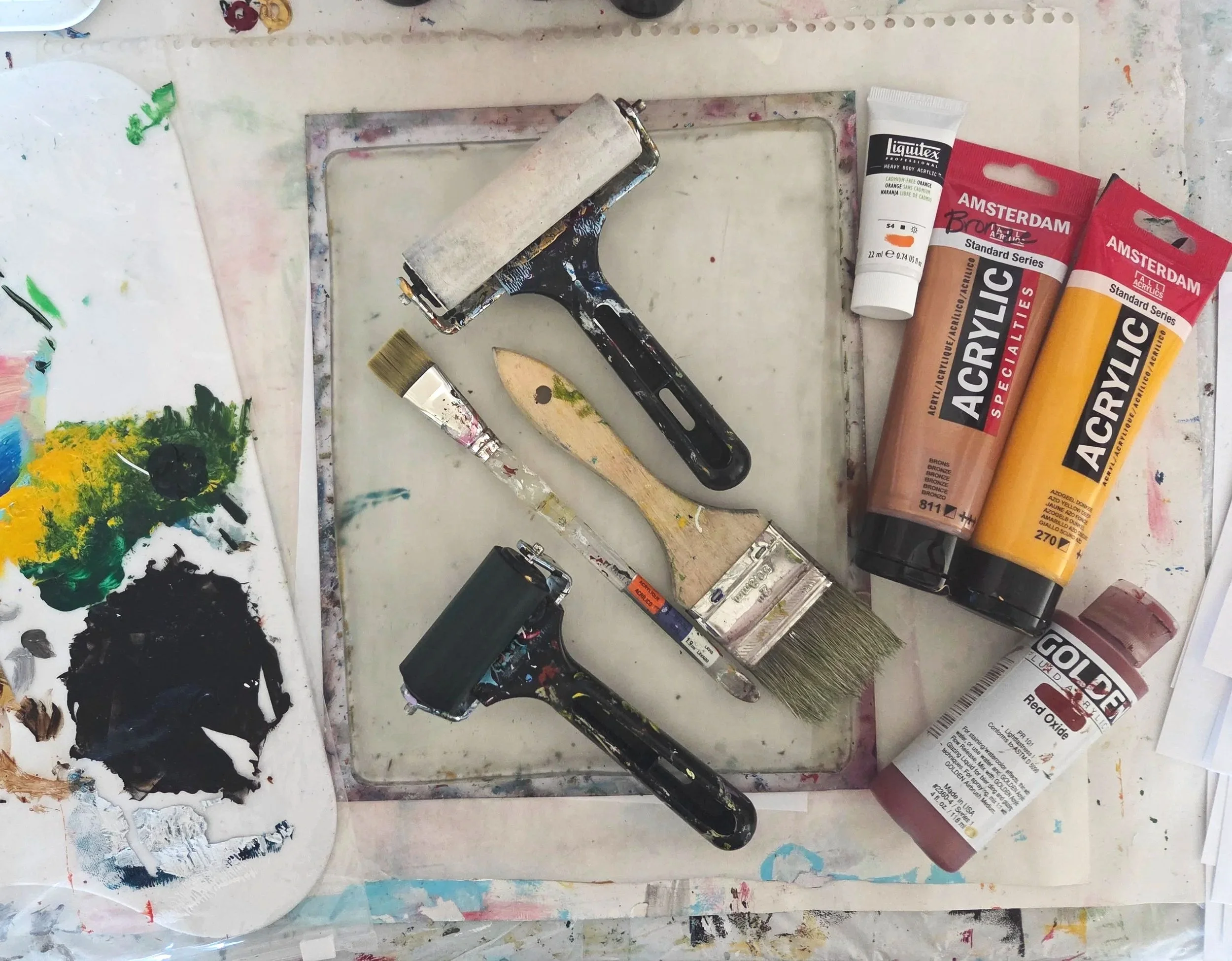
Just a few supplies you will need for gel printing.
Supplies Needed to Create a Gel Monotype Print
Must haves
• Gel plate – they range in sizes and shapes
• Acrylic paint - I mainly use Amsterdam and Golden. I also use Liquitex and Shuttle Art.
• Brayer - I have a hard roller very cheap. Nice alternatives are made by Speedball and Gelli Art.
• A simple set of acrylic brushes will come in handy
• Heavyweight paper - Bristol, mixed media, illustration. I have used every brand under the sun, and they are all great. My prefernce? Strathmore’s bristol. There’s no particular reason I like this best but I think it has jsut become a habit.
• Lightweight paper to experiment on – simple copy paper is fine
• Paper towels
• Water Spray bottle
Optional supplies – These are only some of the possibilities. As you progress with your monotype printing, you may find even more things than are listed here.
· Baren- this is a flat disk with a handle to smooth out paper. Great if you have arthritis or other issues with your hand or wrist.
· Acetate or stencil film for making your own stencils – you could also use a plastic document folder if it is transparent enough to see through (these can be rather flimsy though).
· Store-bought stencils and stamps
· Cutting mat
· Craft knife
· Masking tape (do not use old tape…it might stick to the plate and never come off)
· Photos (there are many ways to do an image transfer beyond what I teach using acrylic paint.)
· Magazine pages – high-quality magazines will transfer, but be aware that magazine images are under copyright laws.
· Laser Printer – if you LOVE image transfers, consider this purchase. You will find inexpensive ones online. One that prints black only will be the least expensive.
· Glue stick – not to be used on the plate itself, but to work on collages
· Matt medium – can be used as a glue in collage work as well as on the plate
· Acrylic Paint pens
· Other papers to print on –wet-strength tissue paper, ordinary copy paper, watercolor paper, or tea bag paper. You could use any paper/wood/fabric/etc. for a substrate. Experiment.
· Adhesive-backed foam sheets and shapes (great for making shapes in the paint)
· Scissors
· Corrugated cardboard - great for making shapes, textures.
· Used art paper pad backing – Once you have used all that heavy paper, keep the cardboard back. This is fairly rigid and can be used to add the foam pieces, glue gun patterns, etc
· Botanicals – leaves, branches (be careful not to puncture your plate), shells, stones, etc. Again, experiment.
· Anything you find will be great for mark-making. The kitchen has a wealth of shapes.
· Acrylic inks, oils, and watercolors can also be used on your plate with different results. Be aware that some things could stain the plate. Anytime you try a new medium, research it to be sure it is compatible with a gel plate.
· Acetone – a sprayer on the bottle is helpful. This make wonderful effects in the paint.
· Eye dropper – to control drops from acetone and/or water
DON’T USE
· Photo paper – When doing any type of image transfer, be very careful not to use photo paper. It can stick to the plate and ruin it.
· OLD masking tape – that sticky, gooey tape that has been in the garage for years will leave glue on your plate. It is difficult, if not impossible, to get off.
· Sharp objects – Anything that punctures the surface of your plate will be there forever, leaving marks in your work.
Books
· Printmaker’s Handbook, by: Jessica Russo Scherr
· Gel Printing for Mixed Media Art, by: Robyn McClendon
· Beautiful Image Transfers: Beginning and advanced techniques for turning photos into beautiful art, by: Nitsa Malik
Websites (shop around to find the best deals on art supplies)
· Gelli Arts - https://www.gelliarts.com/
· Liquitex - https://www.liquitex.com/
· Amsterdam - https://www.amsterdam-acrylics.com/en/
· Golden - https://goldenartistcolors.com/
· Speedball - https://www.speedballart.com/