
Printing on Fabric
Kathie’s Non-Scientific Experiment and Recommendations
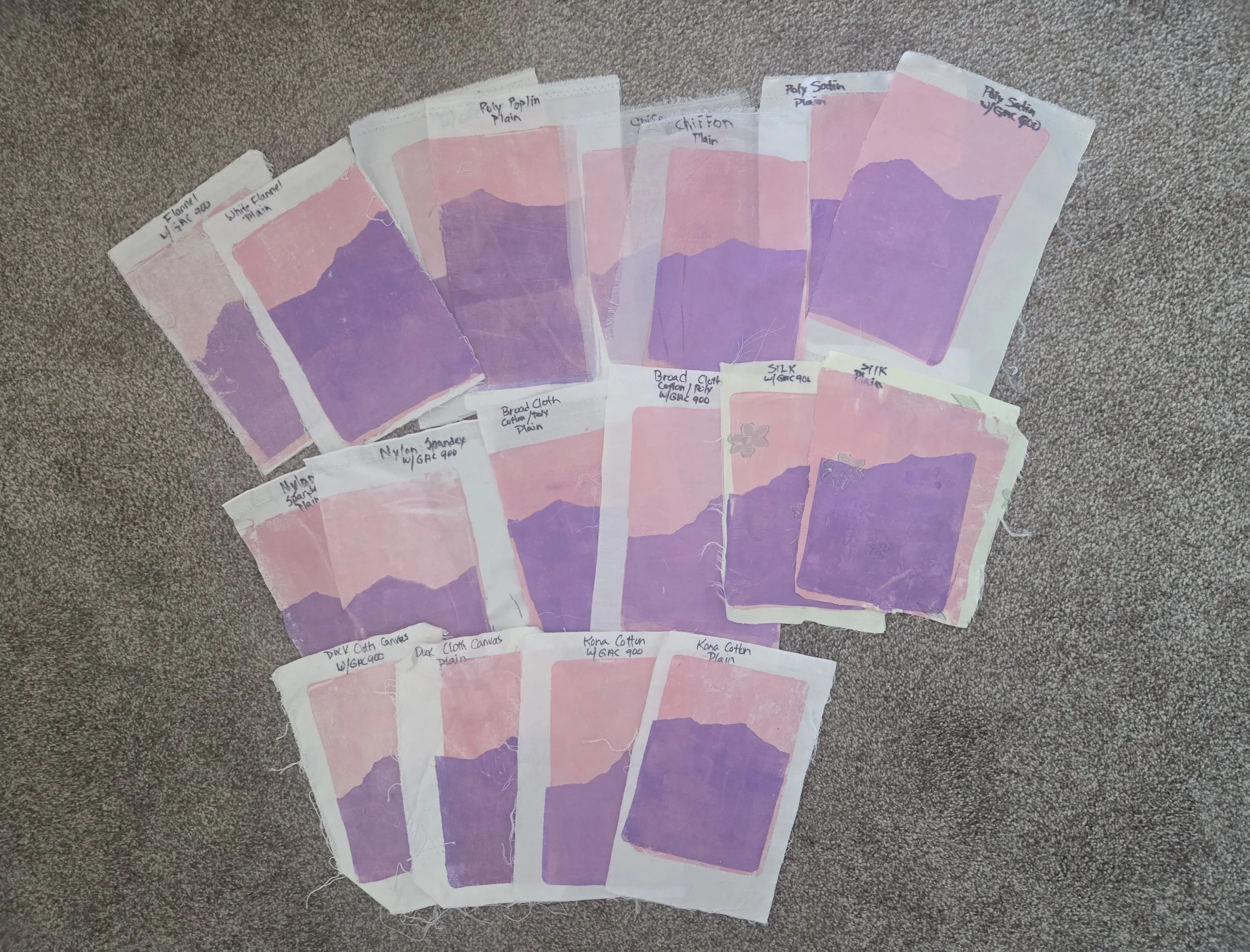
Photo of the fabric swatches. Each is about 7×9 inches. I printed everything from a 5×7 plate.
Printing on fabric opens a whole new realm of printing possibilities. Unlike paper, fabric reacts to paint in different ways. Within the plethora of fabric types, each reacts differently. So, how does a person decide what works and what doesn’t? The answer is to test the fabric, note the result, and choose what best fits the look you want.
I asked myself this and decided to run a little experiment (no science involved) to see what would happen. I went to my local hobby store and bought 1/3 yard of every fabric they carried. The only stipulation was that it had to be white. The one fabric I wanted, they did not carry – Silk. For this, I cut up a retired silk blouse. It is a pale yellow, which only changed the paint color rather than affecting the outcome.
THE PROCEDURE
The procedure was simple: I rolled paint on the gel plate, then transferred it to the fabric as a substrate just as I would with paper. I thought 2 layers of acrylic paint would be a good test for multi-layered art.
I also printed each fabric with two different formulas. One with just acrylic paint and one with GAC900, which is Golden’s heat-set fabric medium. This was mixed 1:1 as per the directions on the bottle.
After printing, I lay each fabric piece out to dry for two days. Usually paint dries in 5 minutes here in the Sonoran Desert, but the monsoons make it somewhat humid. If you live in a high-humidity area such as Houston or Chicago, give the paint at least three days to fully dry.
Next was to heat-set them. I decided to heat set all of them in a hot dryer. This was for both the fabric with GAC900 and the acrylic paint. They merrily spun in the hot dryer for about eight minutes. I have read that it only takes three, but I forgot to pull them out of the dryer at three.
Heat setting can also be done with a hot iron. Sandwich your fabric between parchment paper and press for about three minutes. This is fine for smaller pieces, but if you have something large, a hot dryer will give a more even set.
After letting the fabric pieces cool, I hand-washed all of them in tempered water. The summers here don’t allow for cold water, so I crossed my fingers that warmish water would be fine. I thought about putting them in the washing machine, but controlling the water temperature is harder. I let them soak in soapy water for about five minutes, then rinsed the soap out.
They went back into the dryer until dry. I did not use any kind of fabric softener. The water here is extremely hard, which affected the softness of the fabric, but I could still tell which had the GAC900 and which did not.
THE DETAILS
Now for the details. Remember, this is an experiment I did at home, with really hard water, and no science to back anything up, but it still showed how different fabrics and acrylic paint behaved with one another.
Here are the fabrics I tested:
Broadcloth Poly/Cotton
Poly Satin
Cotton Flannel
Kona Cotton
Duck Cloth Canvas
Poly Poplin
Silk
Chiffon
Nylon Spandex
The Paint I used:
Amsterdam – Persian Rose
Liquitex – Brilliant Purple
Golden – GAC900 Heat Set Fabric Painting Medium
THE RESULTS
The results were varied, from GREAT to “I’m never going to try and print on that again!”
In nearly all cases, the treated paint came out slightly lighter, smoother, and more flexible. The fabric samples were not pre-washed.
Broad Cloth Poly/Cotton – This handled both treated and untreated paint well, although the GAC900 piece is slightly better in color and softness. I would use this fabric in future work.
Poly Satin – I liked this fabric the best for handling with the plate and the results. The paint looks lovely on the fabric. I would say that the GAC900 left the paint more even on the fabric. I will be using this for future monoprints to see how it holds up against four and five layers of paint.
Cotton Flannel – I don’t recommend this for either GAC900 or untreated paint. The fibers drown in the paint and can’t hold it very well through washing.
Kona Cotton – This worked best with the GAC900. The paint is even and looks lovely. The untreated piece is uneven, and the paint was lost in some areas after washing.
Duck Cloth Canvas – This had decent results. Because the material itself is textured, the paint also has a textured look. The paint “cracked” a little more along where the fabric was folded when crumpled in the untreated piece.
Poly Poplin – This was fine with both treated and untreated. As always, the untreated has slightly denser paint and is not as flexible as the other.
Silk – This is one exception to the above statement about flexibility. The untreated paint actually feels more flexible in this instance, but the treated paint held onto the fibers better. This might be that the non-treated paint is layered a little thinner. But the look of the treated paint is smoother.
Chiffon – I won’t ever try this one as a gel print. The fabric itself is so “slippery” that it was very hard to get on the plate evenly. The paint itself set best on the GAC900 piece. The piece without the medium has an uneven shine to it, and it remained on the fabric unevenly. This fabric is better suited for another medium than gel printing, yet it has a lovely look, so if you don’t mind the fiddly nature of chiffon, you’ll love it.
Nylon Spandex – Because of how stretchy the fabric is, neither treated nor untreated paint worked very well. The paint split and sloughed off.
Conclusion
There are many more fabrics out there that I could have tested, but this is what my local shop had on hand. All of the fabrics I tested work as far as paint sticking to the fabric. Each gave a different result and look. Ask yourself, “What is the look and feel I’m trying to achieve with fabric?” Once you decide that, you may want to use flannel or chiffon even though they were not my preference. Ultimately, the best way to discover what works for you is to experiment, explore different fabrics, and let the unique qualities of each one inspire your next print.